FULL-FLEDGED PRE-FEASIBILITY ANALYSIS
Urea-Molasses Multi-Nutrient Blocks (UMMBs) from Agro-Industrial Waste
Market
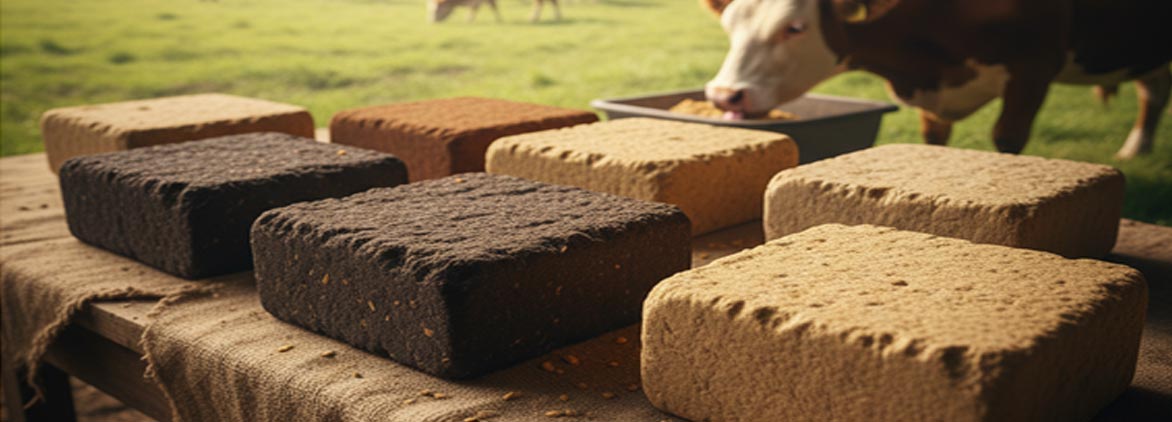
Targeted market | A Urea-Molasses Multi-nutrient Block (UMMB) is a formulated feed supplement designed to provide essential nutrients to livestock, especially ruminants, and is commonly referred to as a multi-nutrient block. It is a solid block produced based on agricultural residue with Crude Protein (CP) content of 12%, 14%, 16%, and 18%. Its lickable format ensures consistent nutrient intake, improving roughage digestion, growth, and overall well-being. UMMB provides energy, non-protein nitrogen, and essential minerals, and can reduce up to 50% of concentrate feed consumption, as up to 30 percent of the total CP requirement can come from the multi-nutrient blocks. The targeted market is the local Egyptian market, mainly the large-scale farms, aiming to improve animal health and enhance milk production for cows. |
Project description | The project aims to produce UMMB by utilizing 15,800 tons per year of agricultural residue and agro-industrial waste, such as tomato cake, olive cake, second-grade dates, sugar beet pulp, molasses, and wheat bran, through mechanical and mixing processes technology. The facility is recommended to be located close to the areas where collected targeted agricultural residue is available in the Delta in El-Behira, Sharqia, Dakahlia, Kafr El Sheikh, and Gharbia. However, they are also available in El-Minya, Assiut, and Beni Suef. Accordingly, the production location is recommended to be in one of the abovementioned Governorates for ease of accessibility and reduced transportation distances of the raw materials. |
Competitive edge | Providing a supplement for ruminants with a high and uniform nutritional value that is less expensive compared to traditional animal feed. About 65 – 80% of the input material is from agricultural residues and agro-industrial waste. Minimize the open burning of agricultural waste by utilizing it to produce high-quality products. Introduction of a new product in the Egyptian market that helps reduce the need for conventional protein supplements, making them cost-effective for smallholder farmers. |
Market features | The Market Size was valued at USD 100 billion in 2023 and is expected to reach USD 147.75 billion by 2031, growing at a 5% CAGR from 2024 to 2031. |
Financial Features
Total annual amount of the products | UMMB with 12% Protein: 1,457 to 1,822 ton/year UMMB with 14% Protein: 1,457 to 1,822 ton/year UMMB with 16% Protein: 4,097 to 5,122 ton/year UMMB with 18% Protein: 5,153 to 6,442 ton/year |
Selling price | The following are the estimated selling prices: UMMB with 12% Protein: 12,388 UMMB with 14% Protein: 13,268 UMMB with 16% Protein: 13,686 UMMB with 18% Protein: 14,469 |
Land area required | Building Area: 1885 m2
Setback Area: 851 m2 |
Investment | 63 million EGP |
IRR | 49% |
Simple payback | 4.4 years |
Process
Required Input | Agricultural and agro-industrial residues = 15,800 ton per year The required input includes yellow corn, wheat bran, soybean meal, tomato cake, olive cake, second-grade dates, sugar beet pulp, and molasses. Additives are included in UMMBs to meet nutritional needs, providing essential calcium, salts, minerals, vitamins, and detoxifiers to help prevent bacterial and fungal infections. The additives quantities are as follows:
|
Process/Technology | Mechanical and mixing processes |
Equipment | Grinders, mixers, hydraulic press machines, and packaging machines. |
Human Resources | Technicians, machine operators, engineers, managers, and drivers |
Risks and Mitigation Measures
Risks and Mitigation Measures |
|
Impacts
Environmental impact | Prevent open burning of agricultural residues and produce high-value-added products. Reduce the methane emissions of lactating cows by 20-27% as a consequence of the improved feed digestibility. |
Social impact | Provides direct and indirect job opportunities. Raising the standard of living for farmers by getting benefit of agricultural waste. |
Location
Location of Supply | The raw materials of the integrated animal feed are available in the Nile Delta Region, mainly in Sharqia, Behira, Dakahlia, Kafr El Sheikh, and Beni Suef (about 29 million tons per year). The production location is recommended to be in one of the mentioned governorates. For ease of accessibility in transportation. |
Studies
| Serial | File name | Download |
|---|---|---|
| 1 | IO animal feed block Fact sheet |